
Reading geopolitics: Cyclonopedia (2008)
On Reza Negarestani's Cyclonopedia: Complicity with Anonymous Materials.


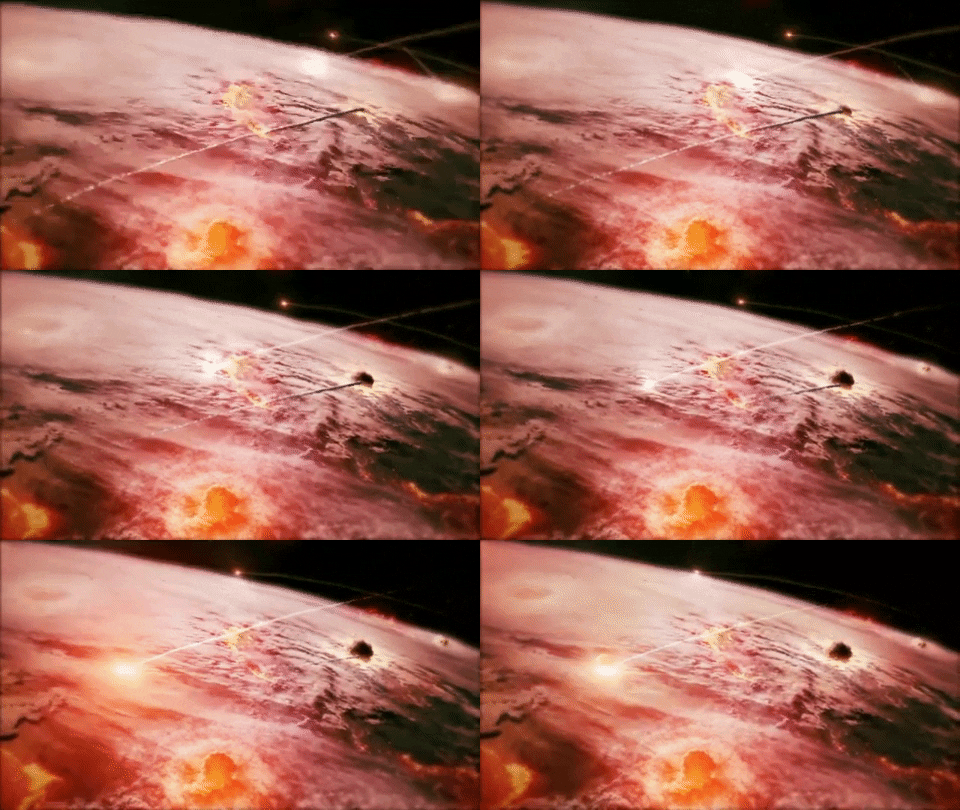
On October 31, 2023, a Houthi medium-range ballistic missile arced high enough to force Israel’s Arrow-3 interceptor to engage it more than 100 miles above Earth’s surface, beyond the Kármán line. The warhead was destroyed while technically in space, making the interception one of the first truly kinetic military actions to occur off-planet. What had been a regional missile exchange thus briefly crossed a threshold long treated as conceptual rather than operational. Warfare, however preliminarily, has entered the extraterrestrial domain. Historians of the future will treat this event as G. W. F. Hegel treated Napoleon’s arrival in Jena in 1806: the moment in which a new historical order becomes perceptible in a single trajectory (“to understand Napoleon is to understand him in relation to the whole of anterior historical evolution”). As Joanna Rozpedowski writes, addressing the broader context of astropolitics, “Every war is a space war now.”
Of course, the ongoing conflict in Yemen is inseparable from the petropolitical architecture of the region. Yemen itself is not a major oil producer, but it sits astride the Bab el-Mandeb strait, a chokepoint through which a significant portion of Gulf hydrocarbons transit toward European and Asian markets. Control, disruption, or even the credible threat of interference in this corridor reverberates through global energy pricing and maritime security operations. The war’s regionalization – and particularly the involvement of Saudi Arabia and Iran – cannot be disentangled from their positions with the petropolitical order: the former as a central exporter and OPEC powerbroker, the latter as a rogue state and sanctioned producer leveraging asymmetric tools (e.g., shadow fleets) within that same system.
Reza Negarestani’s groundbreaking work of theory-fiction Cyclonopedia: Complicity with Anonymous Materials (2008) takes the very idea of petropolitics and radicalizes it. Cyclonopedia first stages itself as a mystery. A woman named Kristen Alvanson goes to Istanbul to meet the author Reza Negarestani, but he never materializes. Instead, a thick, oddly assembled manuscript appears mysteriously in her hotel room. The remainder of Cyclonopedia consists of that manuscript, which relays the work of (the metafictionally nonexistent) Dr. Hamid Parsani. The text characterizes Parsani as a disappeared Iranian academic (an “archeologist and researcher of Mesopotamian occultural meltdowns”) whose research into the deep history of geopolitics (especially the mutually parasitic relationship between violent political Islam and the Western “War on Terror”) and the materialist lifeworld of oil itself, conceived by Parsani as a form of non-human intelligence, is its medium and substance.
Indeed, the core idea imputed to this eccentric theorist is that oil is literally alive, though its mode and scale of life articulates itself rather differently than ours. Indeed, from Parsani’s point of view, all of human history is a launch platform for the autopoietic self-expression of this alien substance. We are oil’s playthings, as our civilizations demonstrate through their contortions, writhing like so many junky leviathans. On Parsani’s account, oil is also a geopolitical and ontological lubricant, intensifying the deathly spirals of various incumbent and novel war machines – namely, those locked in interminable conflict, at different speeds and on different timelines, ranging from the interminable resource wars of the present to the paleopolitics of life itself in our planet’s distant past. Recall the fact that it takes tens to hundreds of millions of years for oil reserves like ours to develop, as well as the presence of mass quantities of organic matter. Oil is fossilized sunlight. Ancient marine microorganisms captured solar energy through photosynthesis, were buried in oxygen-poor (anoxic) sediments, transformed under heat and pressure into hydrocarbons, and then migrated into geological traps over millions of years. Solar politics, indeed; eat your heart out, Bataille.

Throughout the manuscript (which consists of fragmentary high theory essays exploring a range of highly speculative, intellectually deranged theoretical frameworks, hypotheses, and processes), Parsani teases out the material and metaphoric resonance of oil and its origins: as a “post-apocalyptic entity composed of organic corpses flattened, piled up and liquidated in sedimentary basins (mega-graveyards),” as the “black corpse of the sun,” as an “autonomous chemical weapon belonging to earth as both a sentient entity and an event,” as “Go-Juice,” the principal “culprit in making great distances accessible by applying pressure, pushing the flow to the furthest recesses of the globe.” Parsani writes, “Events are configured by the superconductivity of oil and global petrodynamic currents to such an extent that the progression and emergence of events may be influenced more by petroleum than by time.”
This obtains not only regarding distributed petro-infrastructures, but also affects the narratological frameworks in which civilizational conflict, destiny, and history itself is understood. This is Cyclonopedia’s political theological dimension: “To grasp oil as a lube is to grasp earth as a body of different narrations being moved forward by oil,” especially the mutualistic intervermiculation of Islamic and occidental war formations. Not antagonists in isolation, driven to barbarism by one idiosyncrasy or another, but coupled processes, each functioning as a partial organ of the other’s reproduction: Which is the fig and which the wasp? In sum: “The cartography of oil as an omnipresent entity narrates the dynamics of planetary events.”
On the one hand, there is ample precedent for theorizing and thinking in this wild mode (the obvious reference points here are the work of the CCRU and especially Nick Land, but I leave this context aside for now). Literarily, consider sources as diverse as Gore Vidal’s hypermediated novel Duluth (1983), in which characters of the eponymous city transmigrate through media dimensions in death, the very grammar of their reality manipulated by obscure alien beings from outside the text, or Mark Danielewski’s now-classic hypertextual horror novel House of Leaves (2000), which unfolds its stacked narrative as an unstable architectural labyrinth of footnotes, typographic ruptures, and competing editorial frames. Neither concerns itself overly with the materialist substrate (for that, perhaps try Alain Robbe-Grillet), but rather with the ontological instabilities of mediation itself, flirting with satirical self-implosion as one possible endpoint. In Duluth, the mantid overseers accidentally extinguish the human species with a tense shift (oops!). In House of Leaves, textual excess virtually consumes or deranges the page, mirroring as much as affectionately mocking, e.g., Jacques Derrida’s experimental style in Glas (1974), a practice refracting the dispersed typography of Stéphane Mallarmé’s Un coup de dés… (1897), where each page of the book becomes a spatialized map, perhaps even a code…

Beyond largely stylistic considerations, consider Manuel DeLanda’s body of work: War in the Age of Intelligent Machines (1991) tracks the migration of strategic agency from putatively sovereign decision to machinic network feedback loops and A Thousand Years of Nonlinear History (1997) narrates history as the sedimentation of impersonal flows (lava, markets, microbes, rats) through which human actors are carried rather than enthroned. One also recollects Michael Pollan, who, in his (relatively mainstream) The Omnivore’s Dilemma: A Natural History of Four Meals (2006), writes memorably of the longue durée of agricultural history: “Corn is the hero of its own story, and though we humans played a crucial supporting role in its rise to world domination, it would be wrong to suggest we have been calling the shots, or acting always in our own best interests. Indeed, there is every reason to believe that corn has succeeded in domesticating us.” (Perhaps it therefore comes as no surprise, then, that Negarestani served as chief editor for Urbanomic’s Collapse VII: Culinary Materialism; see especially John Gerrard and Michael A. Morris’ “Corn Bomb: An Extended History of Nitrogen” in that issue.)
On the other hand, what does any of this really have to do with geopolitics – much less irregular warfare in the heavens?
First, it’s worth noting the degree to which experimental writing and political history really are intimately, perhaps even inextricably intertwined.
Compare the august Federalist Papers with the creative cyberpunk chatter of various CCRU conceptual personae (or any of the many other collectives who produce these kinds of speculative productions: Luther Blissett’s Q and the Wu Ming Foundation, or whatever strange clade of vampire linguists lurks behind the misleading façade of Forgotten Languages). After all, the Federalist Papers aren’t simply arguments; they are prototypical hyperstitions, “fictional quantities that make themselves real.” Written by Alexander Hamilton, James Madison, and John Jay under the shared pseudonym “Publius,” they construct a composite authorial intelligence, neither fully fictional nor simply identical with any of the men behind it. Publius is a writing machine for synthesizing and substantiating ideological positions, and the textual complex becomes a speculative engine for manufacturing political futurity under the cover of classical precedent (by placing live contestations over the American trajectory in continuity with the discourse of Roman republican virtue). In comparison, the CCRU’s proliferation of aliases (Professor Barker, Echidna Stillwell, Peter Vysparov, k-punk, eventually including in its dread host a certain Dr. Hamid Parsani...) function less as aspirants to order than as vectors of contagious decay. Where Publius consolidates sovereignty through disciplined Enlightenment prose, the CCRU constructs a swarm of semi-fictional operators (conceptual personae made manifest) whose very unreliability performs the breakdown of agency, authorship, and linear temporality (the so-called Human Security System). Where Publius invokes Rome to anchor a constitutionally secure future, the CCRU invokes the Miskatonic Virtual University, Lemuria, and grimdark AI gods traveling back in time from the future in order to dissolve the present into speculative feedback loops.
As further examples, consider the treaties constituting the Peace of Westphalia (1648), effectively responsible for bringing into legal existence the modern, territorially sovereign nation-state, which now serves as the horizon of possibility for global politics. The Balfour Declaration (1917), a brief letter from Arthur Balfour to Lord Rothschild announcing British support for the establishment in Palestine of a “national home for the Jewish people,” reconfigured imperial commitments, catalyzed competing national movements, and helped inaugurate a century of geopolitical struggle. It was, in effect, a single performative sentence that materially reterritorialized the terrain of the Middle East. A single speech act can bring an entire geopolitical world of possibility into being; pseudonymous essays can midwife the constitutional order of one of the world’s most consequential superpowers.
Is it even possible to understand geopolitics without modes of experimental writing attending it?
Second, Cyclonopedia is a sustained exploration of Earth’s interiority breaking out. The planet’s material unconscious, so to speak, is reframed not as mute geological depth, but as an active, pressurized inside that insists on surfacing, whose traumatic breach drives and shapes the strangeways of geopolitical conflict and development.
When, more than now, has geology figured quite so obtrusively at the human scale?
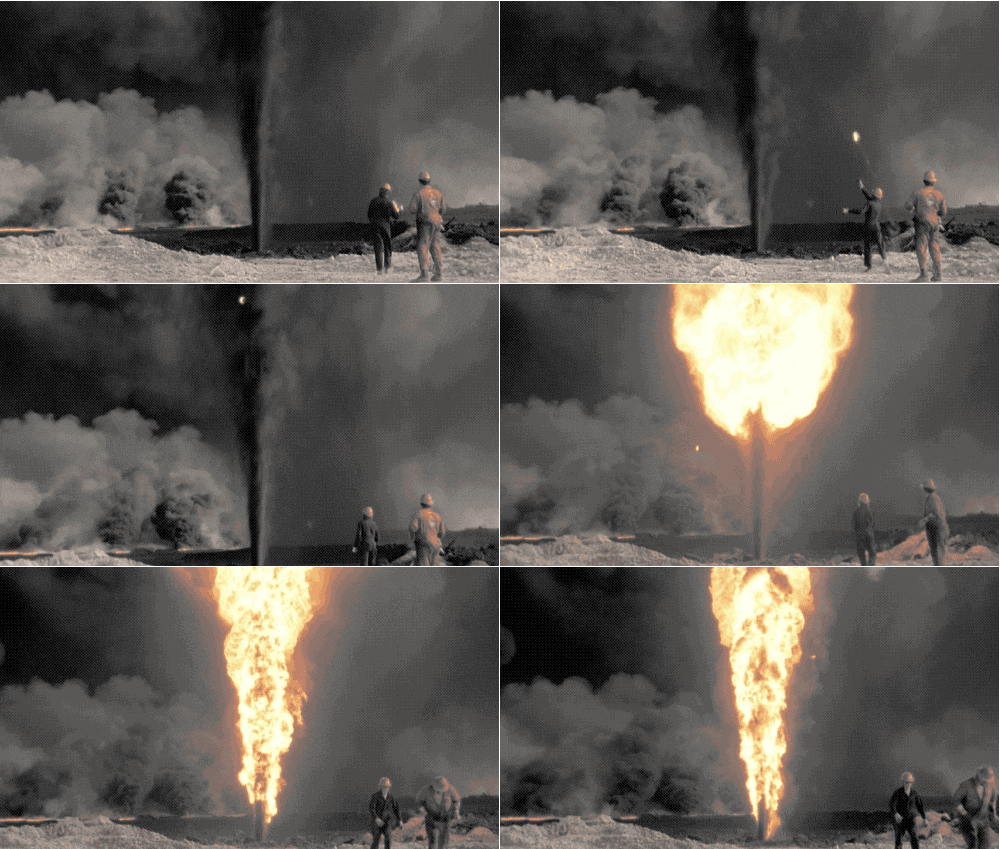
For Parsani, oil is the privileged medium of this eruption; it is the liquified residue of buried life forcing its way upward through the sedimentary strata of geographies, cultures, and concepts alike. What appears on the surface to be imperial expansion or guerilla warfare, hegemony or jihad, is recast as the outward expression of subterranean material processes, as the seepage of our planet’s own compressed geotraumatic history into political time. The desert is no longer a backdrop, but a porous membrane, and pipelines, refineries, and wells become the conduits through which the Earth speaks in mad black tongues, channeling an anonymous material that enables and steers geopolitical events toward the self-inflicted planetary auto-da-fé of the present.
It’s not just that petropolitics figures so prominently in the savage ecology that cashes out in the distributed infrastructures of missile systems and defense – the long chain of production and supply running from extraction and refinement to propulsion and guidance, from desert wellhead to exo-atmospheric interception. Fossil modernity underwrites all these components. But the significance of the October 2023 kinetic event exceeds what is familiar here, and the event marks a shift in topology more than an escalation in scale. Indeed, in military terms, the scale is quite modest. This was not the long-feared thermonuclear exchange between superpowers, depictions and projections of which formed the apocalyptic imaginary of the Bomb in the mid-to-late twentieth century.
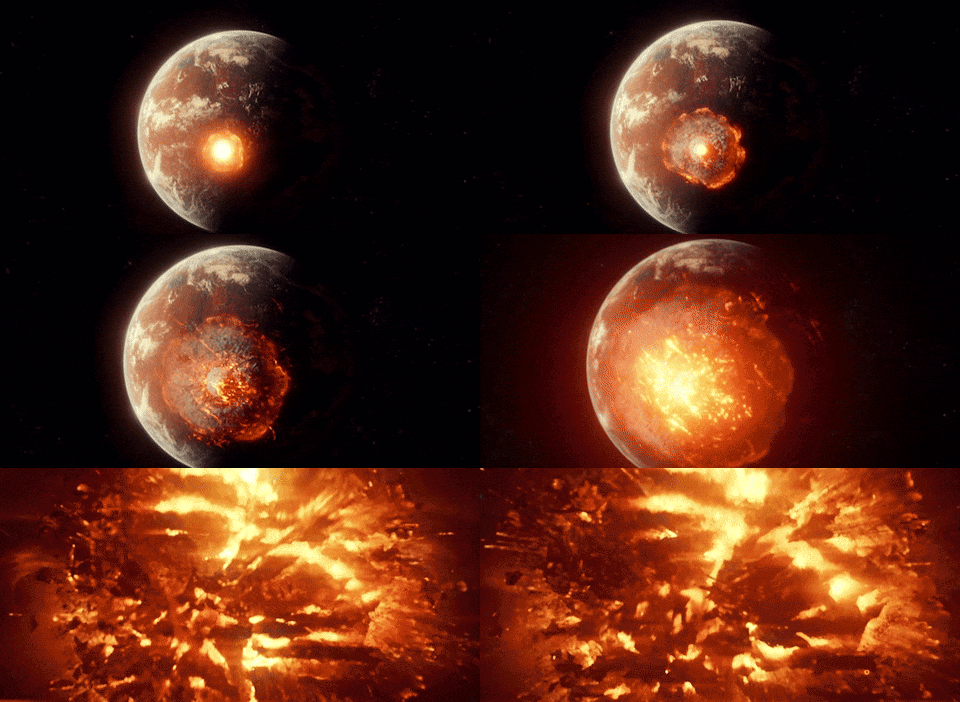

Most significant here is the becoming-extraterrestrial of geopolitical conflict and partisan warfare, and with it a fundamental renegotiation of the spatial order in which politics unfolds. The event carries petropolitics off-world, however briefly, and in so doing changes the nature of all terrestrial politics. The typical circumscription of the terrestrial is breached; the interior breaches the exterior; the planet opens itself to the Outside.
If we take Parsani with deadly seriousness for a moment, and construe oil as an anonymous material agency – the impersonal driver of geopolitical history, proliferating itself through antagonisms, psychodynamics, and infrastructures alike – then this ascent marks a peculiar inflection point. Negarestani’s desert is metaphysically vertical, riddled with shafts, wells, and infernal ascents, and yet it remains terrestrially bound. Its verticality tunnels downward. The becoming-extraterrestrial of geopolitics, by contrast, signals a notional breakaway, a moment in which conflict, propelled by the very petro-infrastructures Negarestani anatomizes and satirizes, crosses into a novel domain. This does not abolish petropolitics. Hydrocarbons still finance the arsenal, ignite the missile, and underwrite the planetary order. But a new dichotomy flickers at the world’s edge: the conjunctive disjunction of the terrestrial and the extraterrestrial, of telluric insurgency and orbital interception.
The missile’s ascent stages a double movement. It realizes Negarestani’s intuition in the most literal sense – the unlife of petroleum flaring into kinetic force – while also displacing the scene of conflict into a voidal domain that oil cannot directly territorialize. The same hydrocarbons that subsidize, fuel, and accelerate this minor confrontation propel it beyond the infrastructures that ordinarily anchor, constrain, and drive geopolitical struggle. Violence is lifted out of the desertifying world and momentarily suspended in orbit. What takes shape is a nascent spatial polarity: not just land and sea, or surface against depth, but a planet breaking apart or breaking away from its own subterranean bondage.
What forms of unlife can a missile carry?

I'll just post my earlier comment here for the sake of expediency:
I really enjoyed the speculative swerve of this one: allowing theory-fiction to strange-ify the historical juncture of extraterrestrial conflict.
However, I take a somewhat sideways view of the same landscape. Which is to say, I’m suspicious of speculative reason as a tool of analysis when it overindulges in it’s distortions of the real movement and life of materials. Such overindulgences can indeed open up new imaginaries, but they can also foreclose (or mask) significant and hard won understandings of the actual determining ecological relations in which human geopolitics operate.
For me this condenses into questions of ecoliteracy, and the lack thereof for the majority of citizen actors. The already high degree of ecological blindness can be easily increased by theory-fiction that posits agency and intentionality where none exists, facilitated by a warping and mutilating the notion on agency as such, and by suggesting geopolitical horizons that confuse the shape of real networks and consequential nodal relations.
Oil has no agental powers capable of self-organizing into machinations to escape the ground to shape civilizations into platforms — any more than capitalism is an ‘alien intelligence from the future’. Both of those speculations attempt to highlight very complex relations via corrective emphasize of the role of oil and capitalist systems, respectively, but fail to offer anything nearing strategic insight or ethical accounting. Oil’s materiality and affective character is already well-studied (quite the opposite of anonymous), and more accurately understand ontographically as a particular kind of material potency entangled in human affairs, rather than as an agential force with intentionality.
Reza’s misleading speculative reasoning re: the role of oil in the evolving assemblages that make up humans social systems leads to distorted political imaginaries where genuine agents (i.e., oligarchs, politicians, corporate campaigns) as nodal forces who actually drive contemporary systems and feedbacks receive less attention (and blame), which, then, in turn, weakens political strategy and tactical effectiveness.
To be clear, this is not a call for lazy or naïve realism, but, rather, a plea for a critical or radical or “wild” ontographic pragmatism that seeks more productive and adaptive unions of speculative thought and the empirical sciences — with novel admixtures of conceptual and practical concerns.
“Ecology is, simultaneously, a thing we know and a thing we do. It is science and action. Thought and movement. It must be both, not fully reducible into either category.” — ecologist Ben Lockwood.
I think i’m more interested in evolutionary praxis and mutant geopolitics that creatively synthesize speculative and empirical modes rather than in adding to the already prolific ontological confusions rampant within the general populous, and fetishized by non-grounded intellectuals such as CCRU, Land, some strains of accelerationism, and Reza’s early work (which he himself has now moved away from).
Perhaps we might see this as a type of Grand Bargain between speculative theory and empirical research that is always mindful in it's operations to always tether itself to the real, but in not-so-simple ways?
See also: "The Insistence of Possibles: Towards a Speculative Pragmatism" (2017), by Isabelle Stengers for adjacent thoughts: https://doi.org/10.70733/w8eviuefu210
When does speculative creativity become bad ontography? Does concept-creation and imagination engineering ever need to avail itself of reality-calibration? If so, in what ways? And what, if any, are the practical and political consequences when it does not? Just questions in my thoughts as I read this piece...